


Kids Go Kart Turning Radius: How Much Space Do You Need?
Kids go kart turning radius is the space needed to complete a turn at a given steering angle. Parents searching for a number often find that a product page does not publish one for the exact kart. Do not invent it from the vehicle's overall length or a photograph. Instead, measure the actual kart's slow-speed turning path in a controlled space and leave extra room for stopping and adult intervention.
Distinguish a specification from a practical path
Manufacturers may describe a turning circle or turning radius, which are not identical measurements. Tire grip, steering lock and whether the kart is moving can also change the path. If a manual provides a verified figure, use its definition. If not, mark a low-speed trial with cones or soft markers after assembly. An adult should control the trial and keep all walls, people and vehicles well outside the test area.
Start with a large, open practice lane
Do not design the first course around the minimum possible turn. The child needs room to approach, steer gradually and stop if they miss the target. Keep the ground dry and level; avoid pool edges, fences, steps and active driveways. Place markers that can be moved outward if the kart cannot complete a turn comfortably. A wide turn teaches control better than a tight slalom.
Use the exact kart's controls
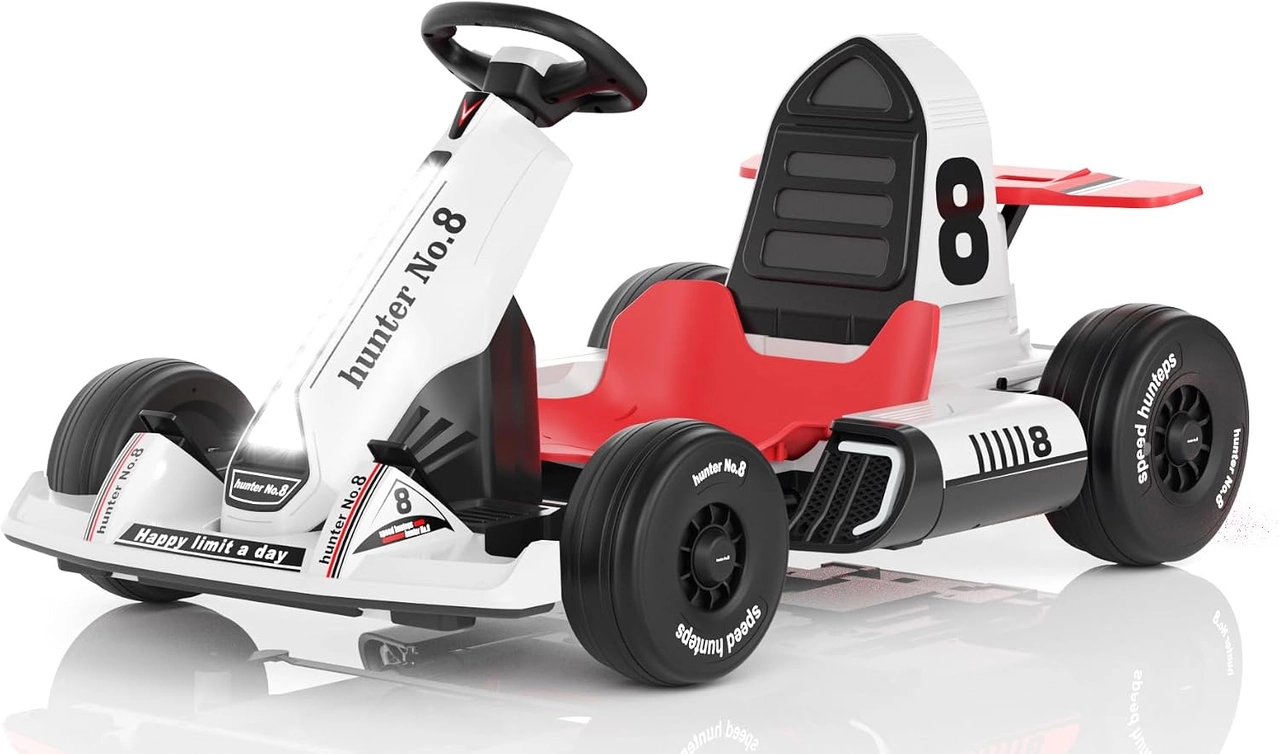
The white XJD 12V electric go-kart listing includes a parent remote and child-driving mode. Those features can help an adult manage a practice session, but its page does not publish a verified turning-radius number. Test the remote before moving, then ask the child for slow, broad turns with a stop cue between attempts. Do not extrapolate from a different 6V or 24V model.
Measure and preserve a buffer
An adult can trace the outer wheel's path after a slow full-lock turn, then add ample clearance for a child's imperfect steering and stopping. The resulting footprint is a site-planning observation for that kart and surface, not a new manufacturer's specification. Reassess if the surface, tire condition or rider changes. If the area is too small to stop comfortably, do not use it for powered riding.
How the current product examples fit
The XJD white 12V kart is a live example with adult-control features. Its product page does not supply the precise turning figure, so this guide shows a safe way to determine space without making up a number. See XJD Electric Go Kart for Kids – White 12V for the exact current options and specifications.
Quick checklist
- Look for a verified manual specification.
- Use a vehicle-free open area.
- Begin with very wide turns.
- Trace the actual path at low speed.
- Leave generous stopping clearance.
Common questions
Can I calculate turning radius from wheelbase alone?
Not reliably. Steering angle and other geometry matter, and a child needs more space than a theoretical minimum circle.
Is a small patio enough?
Only if the exact kart can turn and stop with generous clearance in a fully protected area; do not guess from dimensions alone.
Explore related guides
Use the kids go-kart collection and first-session family plan to compare other suitable configurations without assuming every model has the same features.
Bottom line
Measure the real low-speed path and add room for mistakes. A minimum turning circle is not the same as a safe children's practice course.